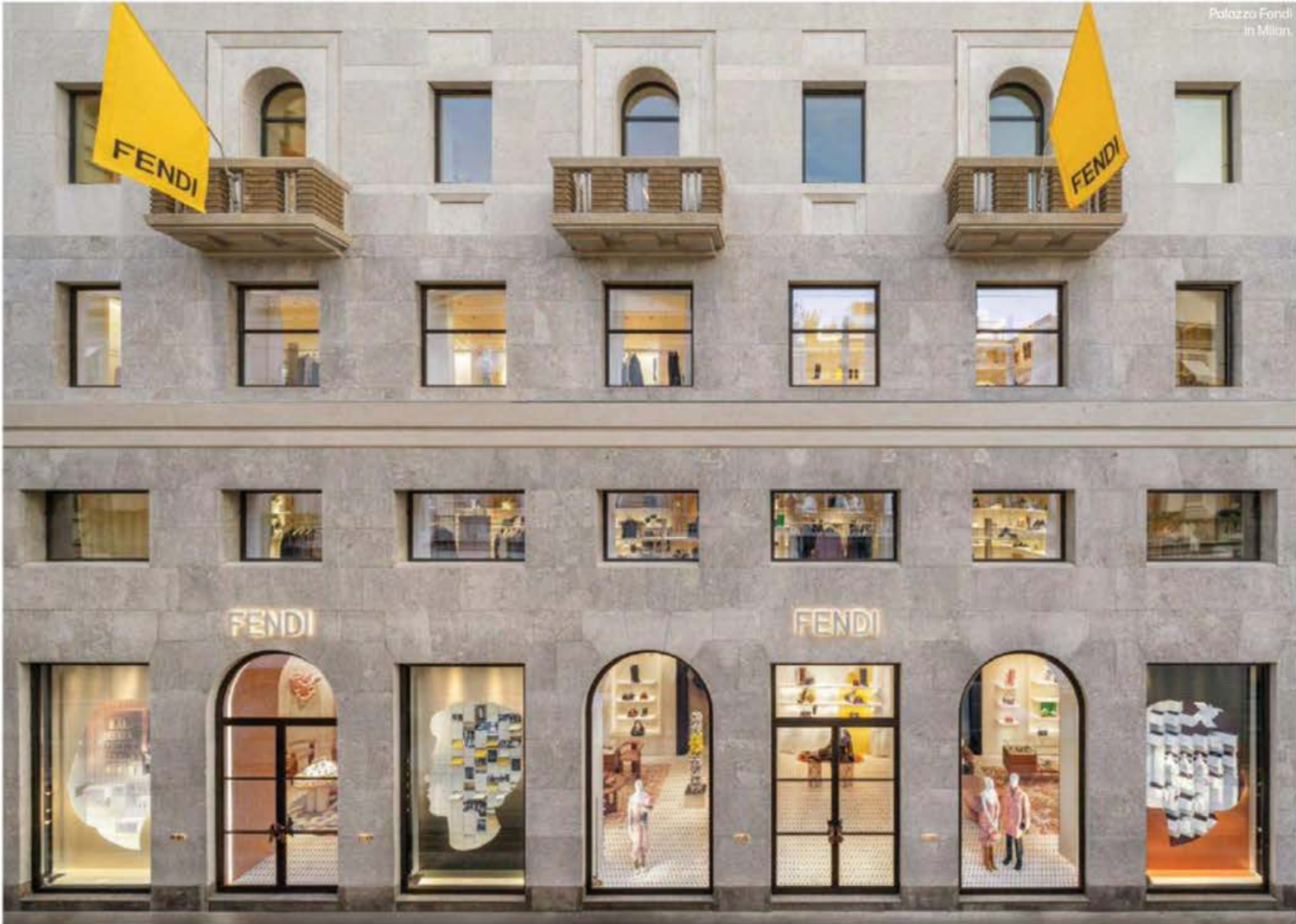
Artefiera 2025

Secci is pleased to announce its participation at Arte Fiera, from February 6 to 9, 2025. For this year’s edition, the gallery will present artists such as:
Giacomo Balla
Alberto Biasi
Giuseppe Capogrossi
Giulio D’Anna
Chico Da Silva
Filippo De Pisis
Leonor Fini
Lucio Fontana
Damien Hirst
Paul Jenkins
Fernand Léger
Osvaldo Licini
Gio’ Pomodoro
Concetto Pozzati
Enrico Prampolini
Gino Severini
Giulio Turcato
Tom Wesselmann
The gallery can be found at Pavilion 26, Stand B/53.
Secci is pleased to announce its participation at Arte Fiera, from February 6 to 9, 2025. For this year’s edition, the gallery will present artists such as:
Giacomo Balla
Alberto Biasi
Giuseppe Capogrossi
Giulio D’Anna
Chico Da Silva
Filippo De Pisis
Leonor Fini
Lucio Fontana
Damien Hirst
Paul Jenkins
Fernand Léger
Osvaldo Licini
Gio’ Pomodoro
Concetto Pozzati
Enrico Prampolini
Gino Severini
Giulio Turcato
Tom Wesselmann
The gallery can be found at Pavilion 26, Stand B/53.
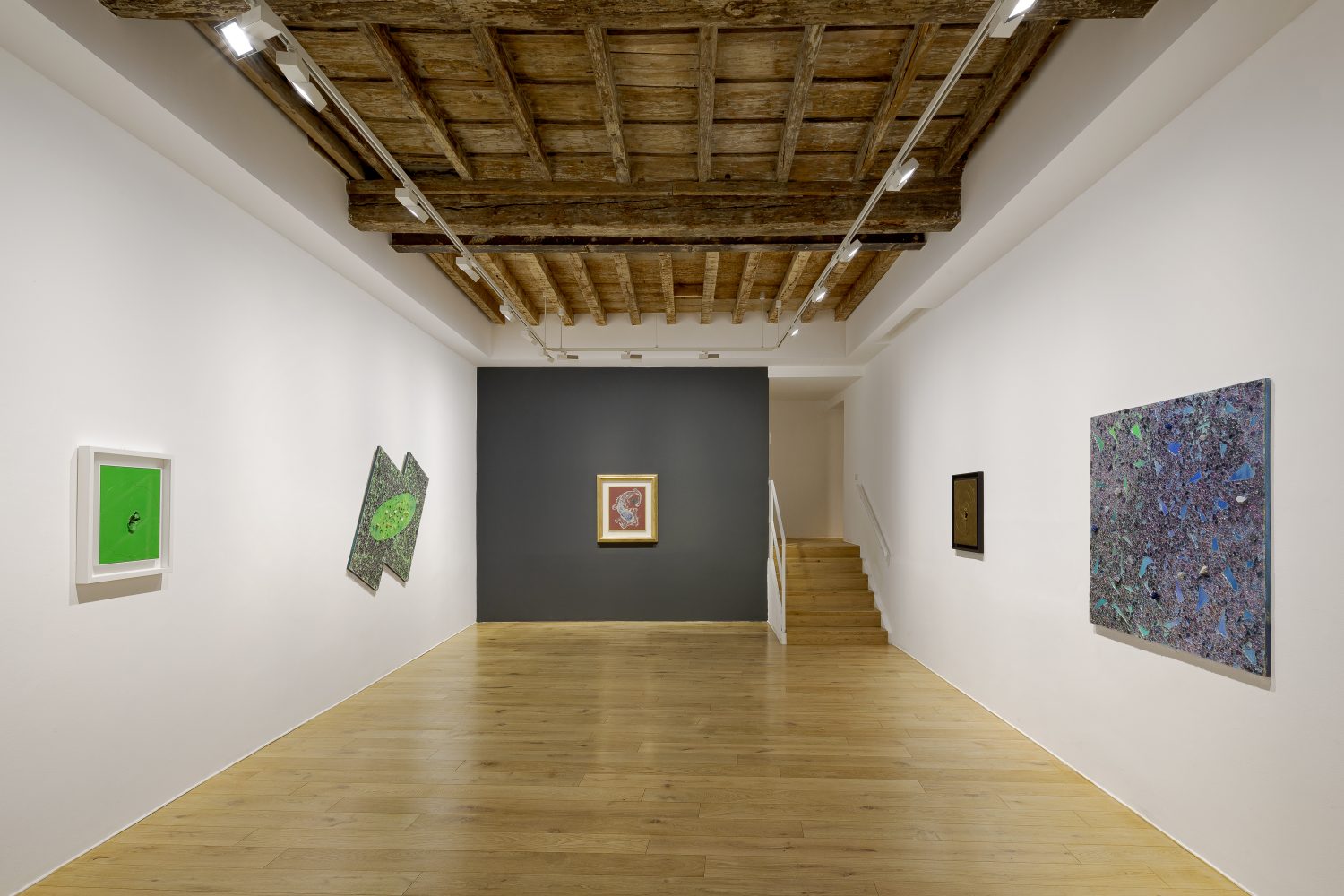
 Installation views, Arte Fiera, Bologna, 2025. Ph Gabriele Abruzzese. Courtesy SECCI
 Installation views, Arte Fiera, Bologna, 2025. Ph Gabriele Abruzzese. Courtesy SECCI
 Installation views, Arte Fiera, Bologna, 2025. Ph Gabriele Abruzzese. Courtesy SECCI
 Installation views, Arte Fiera, Bologna, 2025. Ph Gabriele Abruzzese. Courtesy SECCI
 Installation views, Arte Fiera, Bologna, 2025. Ph Gabriele Abruzzese. Courtesy SECCI
 Installation views, Arte Fiera, Bologna, 2025. Ph Gabriele Abruzzese. Courtesy SECCI
 Installation views, Arte Fiera, Bologna, 2025. Ph Gabriele Abruzzese. Courtesy SECCI
 Installation views, Arte Fiera, Bologna, 2025. Ph Gabriele Abruzzese. Courtesy SECCI


 Installation views, Arte Fiera, Bologna, 2025. Ph Gabriele Abruzzese. Courtesy SECCI
- Installation views, Arte Fiera, Bologna, 2025. Ph Gabriele Abruzzese. Courtesy SECCI
- Installation views, Arte Fiera, Bologna, 2025. Ph Gabriele Abruzzese. Courtesy SECCI
- Installation views, Arte Fiera, Bologna, 2025. Ph Gabriele Abruzzese. Courtesy SECCI
- Installation views, Arte Fiera, Bologna, 2025. Ph Gabriele Abruzzese. Courtesy SECCI
- Installation views, Arte Fiera, Bologna, 2025. Ph Gabriele Abruzzese. Courtesy SECCI
- Installation views, Arte Fiera, Bologna, 2025. Ph Gabriele Abruzzese. Courtesy SECCI
- Installation views, Arte Fiera, Bologna, 2025. Ph Gabriele Abruzzese. Courtesy SECCI
- Installation views, Arte Fiera, Bologna, 2025. Ph Gabriele Abruzzese. Courtesy SECCI
Giulio Turcato was born to Venetian parents in Mantua on 16 March 1912. The family moved to Venice when he was eight years old, where he attended the Liceo Artistico and, subsequently, the Scuola Libera del Nudo.
At the age of twenty-two, he was conscripted into the army and sent to Palermo, where he contracted tuberculosis. The disease plagued him for nearly a decade subjecting him to intermittent bouts of pneumonia during which he was forced to rest. His close rapport with illness revealed to him a biological world of invisibility. He remarked that ‘such a state made me think that one cannot attribute precise and theoretical elements to everything we see.’ Microbes, bacteria and the filaments of life invisible to the naked eye recurred in his paintings later in life, such as Composizione biologica and Batteriologico in 1960, or Composizione microbica in 1961. In the periods he did not spend in sanatoriums, Turcato began showing his paintings in group shows and moved from Venice to Milan in 1936, where he would have his first solo show in 1937 exhibiting Natura morta.
He worked as a draughtsman for the architect Giovanni Muzio, the inventor of Nuovo Design with Giò Ponti. He knew artists in Corrente, a group of anti-Fascist intellectuals including Elio Vittorini and Renato Guttuso. With many of them, Turcato would join the Resistance in 1943 and move to Rome, where he helped sort and distribute copies of l’Unità. The Communist daily would sponsor the exhibition L’Arte contro le barbarie held in August 1944 at the Galleria di Roma, where Guttuso, Mafai, Turcato and others reinterpreted famous revolutionary paintings.
Turcato was at the vanguard of artistic developments and in touch with the international art world in the decade that followed the liberation of Italy. He founded or joined experimental art movements and groups, from Enrico Prampolini’s Art Club (1945) to the Fronte Nuovo delle Arti (1946) directed by Giuseppe Marchiori. Palma Bucarelli’s exhibition Pittura francese d’oggi in 1946 at the Galleria Nazionale d’Arte Moderna and a trip to Paris that same year funded by the Communist organisation Fronte nazionale della gioventù opened up his horizons to the influences of the international avant-garde, such as Arp, Picasso and Kandinsky.
With his co-travellers, who included Carla Accardi, Pietro Consagra and Piero Dorazio, Turcato founded the ‘Marxist and formalist’ group Forma 1 (1947), questioning accepted Communist positions on figurative art. Turcato’s work was included in the first Venice Biennale after the war in 1948, where he exhibited four abstract paintings – part of a series of Composizioni – in the Italian Pavilion.
This year corresponded to a tumultuous time for Italian politics, when the Italian Communist Party (PCI) fought for supremacy against the Christian Democratic Party (DC). Communist cultural strategies tightened: PCI artists were expected to reproduce socialist realist styles and avoid abstraction. As can be seen in his search for an independent style between 1946 and 1956, Turcato was torn between abstraction and realism.
Turcato’s allegiance to the PCI was strengthened with a visit to Poland in 1948, with 40 Italian delegates to the First Global Congress for Intellectuals for Peace held in Wroclaw. This journey produced his series Rovine di Varsavia. In the 1950 Venice Biennale Turcato’s Comizio, a non-representational rally of Communist flags, was exhibited as part of the Fronte Nuovo delle Arti in a room dedicated to abstract artists.
As Cold War paranoia rose, Turcato’s work manifested an intrinsic friction between his attachment to Communist ideology and his desire to engage with the new centre of the art world – New York.
In 1952, during the Korean War, Turcato painted Insetti dell’epidemia (1952) and Massacro al Napalm (1952), which acted as implicit anti-American condemnations of alleged biological warfare attacks by the United States on North Korea. That same year, the artist joined Lionello Venturi’s Gruppo degli otto with, amongst others, Antonio Corpora and Emilio Vedova.
After spending six months in China on a PCI-funded art trip in 1956, Turcato painted Il Deserto dei Tartari and began his series of Reticoli. Turcato left the PCI because of the lack of freedom of expression for artists. As Turcato’s art evolved towards abstraction and experimentation with colour, fluorescence and form, his fame rose: in 1958 he was offered a personal room at the XXIX Venice Biennale; in 1959 he exhibited at Documenta II; and in 1961, with the support of Giulio Carlo Argan, he had a show at the New Vision Centre in London.
Turcato began including fake American dollar bills, as in Composizione Argento Con Dollaro in 1962, the year he travelled to New York. However, the idea that really captured the artist’s imagination, beyond the science of economics, was the science of astronomics, the flight into space. By 1961, the year the Soviet cosmonaut Yuri Gagarin and the American astronaut Alan Shephard orbited the earth within one month of each other, Turcato had painted Astronomica (1959), Cosmogonia (1960) and Tranquillanti per il mondo (1961). Having heard that colour was perceived differently in outerspace, Turcato began experimenting with his series Fuori dallo spettro (‘beyond the spectrum’) in 1962.
In 1964, the same year that Robert Rauschenberg won the Venice Biennale with his pop art collage Retroactive I, Turcato produced his first Superficie Lunare, made from discarded slices of foam mattresses that imitated the pocked surface of the moon. That year Turcato and the cineaste Vana Caruso were married. The artist then joined Vana in Egypt where she was working with John Huston on The Bible. After the trip, he painted Porta d’Egitto and Pronunciamento, both shown at the Marlborough Gallery in Rome in October 1965. A trip to Kenya in 1970 inspired his first series of Oceaniche. These sculptures were exhibited at the 1972 Venice Biennale.
As an internationally affirmed artist, Turcato expanded his creative boundaries, designing jewels and theatre sets, which culminated in the modern dance performance Moduli in Viola/Omaggio a Kandinsky. This was first staged during the Venice Biennale in 1984 at the Teatro Goldoni with Luciano Berio’s musical compositions and Min Tanaka’s choreography and subsequently in Taormina in 1985 at the Teatro Antico with a choreography by Yamanouchi.
Turcato’s paintings from the 1980s and early 1990s continuously sought other dimensions in his experimentation with colour, texture, techniques and sculptural elements.
The last significant solo exhibition was Vedendo at the Banchi Nuovi gallery in Rome in 1992 showing works such as Dune and Le Pacte Signal. In 1994, his works were included in Germano Celant’s exhibition The Italian Metamorphosis: 1943 – 1968 at the Guggenheim in New York. Soon after the closure of the show his eulogy appeared in The New York Times: Giulio Turcato, ‘a prominent member of Italy’s post-war avant-garde’, died aged 83 on 22 January 1995 at his home in Rome in Via del Pozzetto. He had migrated there from his studio in the ‘little kasbah’ of Via Margutta n. 48 where he had lived his early years.
Giulio Turcato was born to Venetian parents in Mantua on 16 March 1912. The family moved to Venice when he was eight years old, where he attended the Liceo Artistico and, subsequently, the Scuola Libera del Nudo.
At the age of twenty-two, he was conscripted into the army and sent to Palermo, where he contracted tuberculosis. The disease plagued him for nearly a decade subjecting him to intermittent bouts of pneumonia during which he was forced to rest. His close rapport with illness revealed to him a biological world of invisibility. He remarked that ‘such a state made me think that one cannot attribute precise and theoretical elements to everything we see.’ Microbes, bacteria and the filaments of life invisible to the naked eye recurred in his paintings later in life, such as Composizione biologica and Batteriologico in 1960, or Composizione microbica in 1961. In the periods he did not spend in sanatoriums, Turcato began showing his paintings in group shows and moved from Venice to Milan in 1936, where he would have his first solo show in 1937 exhibiting Natura morta.
He worked as a draughtsman for the architect Giovanni Muzio, the inventor of Nuovo Design with Giò Ponti. He knew artists in Corrente, a group of anti-Fascist intellectuals including Elio Vittorini and Renato Guttuso. With many of them, Turcato would join the Resistance in 1943 and move to Rome, where he helped sort and distribute copies of l’Unità. The Communist daily would sponsor the exhibition L’Arte contro le barbarie held in August 1944 at the Galleria di Roma, where Guttuso, Mafai, Turcato and others reinterpreted famous revolutionary paintings.
Turcato was at the vanguard of artistic developments and in touch with the international art world in the decade that followed the liberation of Italy. He founded or joined experimental art movements and groups, from Enrico Prampolini’s Art Club (1945) to the Fronte Nuovo delle Arti (1946) directed by Giuseppe Marchiori. Palma Bucarelli’s exhibition Pittura francese d’oggi in 1946 at the Galleria Nazionale d’Arte Moderna and a trip to Paris that same year funded by the Communist organisation Fronte nazionale della gioventù opened up his horizons to the influences of the international avant-garde, such as Arp, Picasso and Kandinsky.
With his co-travellers, who included Carla Accardi, Pietro Consagra and Piero Dorazio, Turcato founded the ‘Marxist and formalist’ group Forma 1 (1947), questioning accepted Communist positions on figurative art. Turcato’s work was included in the first Venice Biennale after the war in 1948, where he exhibited four abstract paintings – part of a series of Composizioni – in the Italian Pavilion.
This year corresponded to a tumultuous time for Italian politics, when the Italian Communist Party (PCI) fought for supremacy against the Christian Democratic Party (DC). Communist cultural strategies tightened: PCI artists were expected to reproduce socialist realist styles and avoid abstraction. As can be seen in his search for an independent style between 1946 and 1956, Turcato was torn between abstraction and realism.
Turcato’s allegiance to the PCI was strengthened with a visit to Poland in 1948, with 40 Italian delegates to the First Global Congress for Intellectuals for Peace held in Wroclaw. This journey produced his series Rovine di Varsavia. In the 1950 Venice Biennale Turcato’s Comizio, a non-representational rally of Communist flags, was exhibited as part of the Fronte Nuovo delle Arti in a room dedicated to abstract artists.
As Cold War paranoia rose, Turcato’s work manifested an intrinsic friction between his attachment to Communist ideology and his desire to engage with the new centre of the art world – New York.
In 1952, during the Korean War, Turcato painted Insetti dell’epidemia (1952) and Massacro al Napalm (1952), which acted as implicit anti-American condemnations of alleged biological warfare attacks by the United States on North Korea. That same year, the artist joined Lionello Venturi’s Gruppo degli otto with, amongst others, Antonio Corpora and Emilio Vedova.
After spending six months in China on a PCI-funded art trip in 1956, Turcato painted Il Deserto dei Tartari and began his series of Reticoli. Turcato left the PCI because of the lack of freedom of expression for artists. As Turcato’s art evolved towards abstraction and experimentation with colour, fluorescence and form, his fame rose: in 1958 he was offered a personal room at the XXIX Venice Biennale; in 1959 he exhibited at Documenta II; and in 1961, with the support of Giulio Carlo Argan, he had a show at the New Vision Centre in London.
Turcato began including fake American dollar bills, as in Composizione Argento Con Dollaro in 1962, the year he travelled to New York. However, the idea that really captured the artist’s imagination, beyond the science of economics, was the science of astronomics, the flight into space. By 1961, the year the Soviet cosmonaut Yuri Gagarin and the American astronaut Alan Shephard orbited the earth within one month of each other, Turcato had painted Astronomica (1959), Cosmogonia (1960) and Tranquillanti per il mondo (1961). Having heard that colour was perceived differently in outerspace, Turcato began experimenting with his series Fuori dallo spettro (‘beyond the spectrum’) in 1962.
In 1964, the same year that Robert Rauschenberg won the Venice Biennale with his pop art collage Retroactive I, Turcato produced his first Superficie Lunare, made from discarded slices of foam mattresses that imitated the pocked surface of the moon. That year Turcato and the cineaste Vana Caruso were married. The artist then joined Vana in Egypt where she was working with John Huston on The Bible. After the trip, he painted Porta d’Egitto and Pronunciamento, both shown at the Marlborough Gallery in Rome in October 1965. A trip to Kenya in 1970 inspired his first series of Oceaniche. These sculptures were exhibited at the 1972 Venice Biennale.
As an internationally affirmed artist, Turcato expanded his creative boundaries, designing jewels and theatre sets, which culminated in the modern dance performance Moduli in Viola/Omaggio a Kandinsky. This was first staged during the Venice Biennale in 1984 at the Teatro Goldoni with Luciano Berio’s musical compositions and Min Tanaka’s choreography and subsequently in Taormina in 1985 at the Teatro Antico with a choreography by Yamanouchi.
Turcato’s paintings from the 1980s and early 1990s continuously sought other dimensions in his experimentation with colour, texture, techniques and sculptural elements.
The last significant solo exhibition was Vedendo at the Banchi Nuovi gallery in Rome in 1992 showing works such as Dune and Le Pacte Signal. In 1994, his works were included in Germano Celant’s exhibition The Italian Metamorphosis: 1943 – 1968 at the Guggenheim in New York. Soon after the closure of the show his eulogy appeared in The New York Times: Giulio Turcato, ‘a prominent member of Italy’s post-war avant-garde’, died aged 83 on 22 January 1995 at his home in Rome in Via del Pozzetto. He had migrated there from his studio in the ‘little kasbah’ of Via Margutta n. 48 where he had lived his early years.

Giò Pomodoro (1930-2002) was born on 17 November 1930 in Orciano di Pesaro, in the countryside of the Marche near Urbino.
In 1945 his family moved to Pesaro, where Giò attended the Technical Institute for Surveyors, earning his diploma in 1951. From 1952 to 1953 he performed his military service in Siena, Bologna, and Florence. In this last city he visited the museums daily and frequented the artistic milieu revolving around Galleria Numero, where he also exhibited his first “informel“ experimentations.
After the death of his father, Giò settled in Milan with his mother, his sister, and his brother, Arnaldo. The artistic and cultural scene in Milan which he frequented at the time was particularly active. After holding exhibitions with his brother at Galleria del Naviglio in Milan and Galleria Il Cavallino in Venice, which were directed by the brothers Carlo and Renato Cardazzo, Giò was invited to the 1956 Venice Biennale, where he exhibited a series of silver works cast over cuttlefish bones that he had dedicated to the poet Ezra Pound and begun creating in 1954.
The following year he collaborated actively with the journal “Il Gesto” and participated in the exhibition Arte Nucleare at Galleria San Fedele in Milan. Along with Dorazio, Novelli, Turcato, Tancredi, Perilli, Fontana, and his brother, Arnaldo, he would go on to organise the exhibitions of the Continuità group which were presented by Guido Ballo, Giulio Carlo Argan, and Franco Russoli.
In 1958 a solo exhibition of his work was held at Galleria del Naviglio and presented by the architect Gio Ponti. The same year, he married Gigliola Gagnoni.
Upon the death of his mother, he moved to his studio in Via Orti 19, which he would share with his brother until 1964. He thus distanced himself from the group that had formed around the journal “Il Gesto” due to theoretical differences and a change in the direction of his work. Having exhausted his explorations of the automatic sign/mark, Giò delved into the problem of the rational organisation of marks and “making marks“ in the reverse with a series of reliefs which he would call Fluidità contrapposta (Contrasting Fluidity). One of these was exhibited at Documenta II in Kassel in 1959.
In the second half of 1958, Giò designed and created his first surfaces under tension, which he presented at Galerie Internationale d’Art Contemporain in Paris in 1959. At the first Biennale of Young Artists held in that same city in 1959, he exhibited a bronze tension and won the first prize for sculpture along with Anthony Caro. In 1961 he held another major solo exhibition at Galerie Internationale. Towards the end of that year, his son Bruto was born.
In 1962 Giò exhibited at Galleria Blu in Milan and at the Musée de l’Athénée in Geneva, and was invited to the 31st Venice Biennale with a solo room and a presentation in the catalogue by Guido Ballo. That same year he signed an exclusivity agreement with the Marlborough Gallery, which he would terminate in 1967.
In 1963 he exhibited at the Palais des Beaux-Arts in Brussels with a critical presentation by Giulio Carlo Argan.
In 1964 the Tate Gallery of London purchased the work One (1960), while at Documenta III in Kassel Giò exhibited a series of surfaces under tension. He also created two large works in the Folle (Mad) series, one of which would be purchased by the Gallery of Modern Art in Rome, and the other, the white marble Grande Ghibellina (Great Ghibelline Lady), went to the collection of Nelson Rockefeller. In 1965 he began the Radiali (Radials) and his first explorations of supporting structures, exhibiting at the Louisiana Museum in Copenhagen and at the Musée des Beaux-Arts in La Chaux-de-Fonds. He worked on the Quadrati (Squared) series until 1966, using strictly the size of two metres by two; these works were exhibited for the first time at the Kunst – und Museumsverein in Wuppertal. After two trips to the United States, where he stayed for a few months, Giò created Black Liberator (1966-67), a work dedicated to African-Americans. In 1967 he exhibited at the Marlborough Gallery in New York. That same year he signed an exclusivity agreement with the Martha Jackson Gallery in New York, where in 1971 he would exhibit his new works – from the Contatti (Contacts) to the Sole di Cerveteri, per Gastone Novelli (Sun of Cerveteri, for Gastone Novelli) – resulting from his in-depth investigation of the supporting structure and the field under tension. In 1968 he began working with Beatrice Monti and Galleria dell’Ariete in Milan, where he exhibited on several occasions. From 1970 on, Pomodoro created large-scale works in stone, marble, and bronze from his studio in Querceta, Versilia, at the foot of the Apuan Alps. In 1972 he began two new series: the Archi (Arches) and the Sole Produttore – Comune Raccolto (Producing Sun – Shared Harvest). In 1974 he exhibited stone works at Galleria del Naviglio in Milan with a critical presentation by Guido Ballo; that summer, his first retrospective was held at the Loggetta Lombardesca in Ravenna, featuring works from as early as 1958. Two years later, it would be followed by two more major solo exhibitions at the Castello dell’Imperatore in Prato city centre and at the Musée d’Ixelles in Brussels, which was presented by Jean Coquelet.
In 1976 Giò exhibited a series of Soli (Suns) at Galleria Stendhal in Milan with a review by Paolo Fossati.
In 1977 he collaborated with the residents of Ales, Sardinia, to create Piano d’uso collettivo (Collective Plane of Use), a large public work dedicated to Antonio Gramsci; he would exhibit its design materials and photographic documentation at Ca’ Pesaro in Venice. That same year, he created the monumental work La Porta e il Sole (The Door and the Sun) for a private collector.
In 1978 Giò designed the set for the opera La Forza del Destino by Verdi, performed at the Verona Arena that summer. That same year he was invited to exhibit at the Venice Biennale with a solo room.
In 1979 he began designing the monumental work Teatro del Sole – 21 Giugno, Solstizio d’Estate (Theatre of the Sun – 21 June, Summer Solstice), a square/fountain dedicated to Goethe which had been commissioned by the city of Frankfurt (the work would be completed and unveiled in May of 1983).
From 1974 to 1980 Giò Pomodoro participated in a number of group shows both in Italy and abroad. In 1980, Giò exhibited one of his most significant works: Luogo di Misure (Place of Measurements) in Piazza dei Signori, Verona. The same year, after having designed the set for Mozart’s Magic Flute, held at at the Teatro La Fenice in Venice, he created the architectural group Ponte dei Martiri – Omaggio alla Resistenza (Bridge of Martyrs – Homage to the Resistance), in the square of the same name in Ravenna.
In 1981, Galleria Farsetti of Focette (Pietrasanta) devoted a solo exhibition to him that was presented by Carlo Ludovico Ragghianti.
In 1982 he began two more major works: the collective use sculpture Spirale ’82 (Spiral ’82) for Società Aeroportuale S.E.A., located opposite Malpensa airport in Milan, and Sole-Luna-Albero (Sun-Moon-Tree), a monumental group for Piazza Ramazzotti in Monza, completed in 1986. That same year, he took part in the exhibition Arte Italiana 1960-1982 at the Hayward Gallery in London.
In 1983, after moving to his new studio in Via San Marco 50 in Milan, Pomodoro exhibited with Dorazio and Nigro at Studio d’Arte Contemporanea Dabbeni in Lugano and then with Tilson and Ipoustéguy in Volterra as part of the exhibition Le materie dell’opera (The Materials of the Work), presented by Antonio Del Guercio.
In 1984 he was again invited to the 41st Venice Biennale with a solo room, and he participated in the exhibition The Language of Geometry at the Kunstmuseum Bern. The same year a large retrospective with works from 1954 to 1984 was organised by the city of Pisa in Palazzo Lanfranchi, followed by an exhibition on the mythological theme of Hermes at Galleria Stendhal in Milan.
In 1985 Studio d’Arte Contemporanea Dabbeni in Lugano held a solo exhibition of his work; at the same time, the city of Lugano publicly presented his series of sculptures devoted to Hermes for the first time – in their entirety – in its Palazzo Civico. The exhibition was a tribute to Giò Pomodoro by Károly Kerényi, the illustrious scholar of Greek myth and religion, who had lived for a long time in Ascona. Also in Lugano, his monumental sculpture Montefeltro – i passi e il volgersi (Montefeltro – Steps and Turns) was permanently installed at Villa La Favorita.
In June of 1986 Giò was invited to exhibit his works in Veksø at the exhibition Veksølund- Kopenaghen, presented by Jetta Sorensen.
In 1987 his exhibition on the theme of Soli (Suns) was held at the at the old Oratory of the Passion in the basilica of Sant’Ambrogio, Milan, in cooperation with the City of Milan, with a presentation by Luciano Caramel. That autumn, he opened a solo exhibition at Galleria l’Isola in Rome with a review by Giovanni Carandente. In December of the same year a retrospective of his work presented by Tommaso Trini was held in Palazzo dei Leoni, Messina.
In 1989 the City of Milan dedicated another major retrospective to him titled La scultura e il suo disegno, presented by Guido Ballo and held in the Rotonda della Besana. That summer, the large bronze sculpture Sole Aerospazio (Sun Aerospace) was unveiled in Piazza Adriano, Turin. It had been donated to the city by the Società Aeritalia for the twentieth anniversary of its founding and was presented in the catalogue with a review by Paolo Fossati.
In 1990 the exhibition Luoghi scolpiti fra Realtà e Utopia, curated by Caterina Zappia, was held in Villa Renatico Martini in Monsummano Terme.
In 1991 the Foundation Veranneman dedicated a major solo exhibition to Giò in Belgium; that summer, the monumental group Luogo dei Quattro Punti Cardinali (Place of the Four Cardinal Points) was unveiled; located in the public gardens in Taino opposite Lake Maggiore and Monte Rosa, the work was reviewed by Dario Micacchi.
In 1992 the Archaeological Museum of Milan with the cooperation of Johnson, the medal-making company, held a solo exhibition of medals which Giò had made starting in 1979; additionally, the funerary monument that he had dedicated to the tenor Mario Del Monaco was installed in Pesaro. That same year, Giò exhibited at the Galleria Ugolini in Rome and at the 18th Triennale di Milano; lastly, in November, the monumental stele Spirale per Galileo Galilei (Spiral for Galileo Galilei) was unveiled; made of bronze and granite, the work was set in the city centre of Padua, opposite the University. The sculpture was the result of a lengthy collaboration between Pomodoro and the university where Galileo held a teaching post from 1592 to 1610 and laid the foundations for the birth of modern science.
In 1993 the Genia Schreiber University Art Gallery in Tel Aviv hosted works by Giò in a major solo exhibition titled Giò Pomodoro – Sculptures & Drawings curated by Mordechai Omer. At the same time, he unveiled the work Solar Stairs – Homage to Kepler, which was purchased by a private donor and installed opposite the main entrance to the University of Tel Aviv.
In March of 1994 the marble model of the sculpture Sole Aerospazio (Sun Aerospace) was installed at the entrance to Turin’s Galleria Civica d’Arte Moderna e Contemporanea; Pomodoro donated the work to the Gallery. In concurrence with this event, the themed exhibition Tensioni 1958-1993 (Tensions, 1958-1993) opened at Galleria Berman in Turin and was presented by Angelo Dragone.
The same year, Pomodoro participated in the exhibition The Italian Metamorphosis, 1943-1968, held at the Guggenheim Museum of New York, and in the autumn he exhibited a selection of his works in the antique shops of Milan’s historic Sant’Ambrogio neighbourhood, an event presented by Alberto Fiz.
In 1995 Giò was invited to sit on the board of the International Sculpture Center (ISC) in Washington, D.C. After holding a solo exhibition presented by Giovanni Maria Accame in May at Galleria Spazia in Bologna, in the autumn of 1995 Giò Pomodoro was invited by the director of the Yorkshire Sculpture Park, Peter Murray, to exhibit his works in that prestigious British exhibition park near Wakefield and later at the Accademia Italiana in London.
At the same time, the City of Venice collaborated with the Venice Biennale and the company Uno A Erre S.p.A. in Arezzo to organise a major retrospective exhibition titled Ornamenti (Ornaments) in the exhibition spaces of the Fondazione Querini Stampalia so as to document the sculptor’s extensive work in gold starting in 1954. During the following year, the exhibition would travel with Uno A Erre and the company Cesari & Rinaldi to Arezzo, Tokyo, and New York.
In 1996, a large retrospective was held in the Sala d’Arme at Palazzo Vecchio in Florence. Along with other bronze and marble works, the exhibition featured a large number of paintings on handmade paper of considerable size on a theme dear to Pomodoro: the sun. The same space also displayed the design and scale model for the monumental work Sole per Galileo Galilei (Sun for Galileo Galilei). During that summer, Pomodoro created a series of large granite and iron works in the San Piero quarry on the island of Elba; conceived using the ancient dry-stone technique, they were dedicated primarily to the island’s traditional activities.
In September of 1997, the large sculpture Sole per Galileo Galilei was unveiled in Piazza Poggi on Lungarno Serristori: the work, made of bronze and pietra serena, is approximately nine metres tall and was donated by Giò Pomodoro and Franca and Tullio Berrini to the city of Florence.
In the spring of 1998, works by Giò Pomodoro were exhibited in Padua’s Palazzo del Monte di Pietà, the headquarters of the Cassa di Risparmio di Padova e Rovigo bank, which sponsored the prestigious event. With sculptures and drawings by the master as well as photographs by Lorenzo Cappellini, the exhibition documented over forty years of investigation in sculpture and painting.
On the occasion, a large marble, Sole Caduto – a Galileo (Fallen Sun – For Galileo), was
displayed in Piazza del Duomo. That July, the Regional Authority of Valle d’Aosta and the St. Benin exhibition centre held Giò Pomodoro: pietre e marmi 1965-1997, presented by Antonio Del Guercio. In addition to the sculptures and large-scale paintings displayed in the Museum, the city of Aosta also hosted three monumental works by the sculptor in three open-air spaces.
During the autumn of 1998 the exhibition Giò Pomodoro – sculture e carte 1958/1998 opened in Galleria Fumagalli in Bergamo, a gallery with which he began actively collaborating; at the same time, the Egyptian Ministry of Culture invited Pomodoro as a guest of honour to the 7th International Cairo Biennial, where large paintings and sculptures of his were arranged in a solo room. In November, Gio’s work featured in the exhibition Studi per grandi opere 1954-1994 at the Galleria Berman in Turin.
In 1999, as part of the Arte Fiera in Bologna, large bronze sculptures were presented in a pavilion that Galleria Fumagalli dedicated to Pomodoro; that spring the Foundation Veranneman again hosted a large exhibition of works by Giò, where a selection of jewellery made by the sculptor was on display alongside large works on paper and sculptures. At the end of the exhibition, the Foundation Veranneman purchased the large Sole caduto – a Galileo in white Carrara marble for its sculpture park. In November he was invited as a Master Artist to hold a workshop at the Atlantic Center for the Arts in Smyrna Beach, Florida.
In April of 2000 Giò Pomodoro was awarded the Guglielmo Marconi International Prize for Sculpture; in May the Town of Laives and the Autonomous Province of Bolzano organised an exhibition of his works titled Sul sole e sul vuoto, curated by Pier Luigi Siena, with a review by Marisa Vescovo. They also purchased the large bronze Solar Stairs – Homage to Kepler currently installed opposite the school in Laives.
In June, he was invited by the Chancellor of the University of Urbino, Professor Carlo Bo, to the chancellor’s assembly hall for the presentation of a book edited by Giovanni Maria Accame, Giò Pomodoro: opere disegnate 1953-2000.
That July, a large exhibition of sculptures and drawings, Tensioni e Soli, was hosted in the Museo San Pietro in Colle di Val d’Elsa.
In December of 2000 Giò participated in the prestigious exhibition Novecento: Arte e Storia in Italia, curated by Maurizio Calvesi and Paul Ginsborg and organised by the City of Rome.
In February of 2001 the Italian Cultural Institute in Cologne dedicated a solo exhibition to Giò Pomodoro’s paintings. In October, on the occasion of the G8 summit and as part of the exhibition Artisti Italiani del XX secolo: dalla Farnesina alla Stazione Marittima, the monumental sculpture Sole – agli Italiani nel mondo (Sun – For the Italians in the World) was unveiled; it was donated to the city of Genoa and to its port by the company Grandi Navi Veloci. This was the last monumental work that the artist managed to see installed.
In April of 2002, the International Sculpture Center granted Giò the prestigious Lifetime Achievement Award in Contemporary Sculpture: he was the first Italian artist to receive the award. To mark the occasion, Milan’s Galleria Giorgio Marconi dedicated a tribute to Gio’, arranging a solo exhibition of sculptures and large-scale watercolours. Lastly, in July, Giò took part in the fifth In Chartis Mevaniae exhibition organised by the Towns of Bevagna and Spoleto and curated by Giovanni Carandente.
Giò Pomodoro passed away in his studio in Milan on 21 December 2002.
In the years that followed, a number of public works which the sculptor had designed for the community were unveiled: on 1 March 2003, the large Vela (Sail) in memory of Carlo Bo was installed on the promenade of the historic centre of Sestri Levante; in June of 2004, Sole deposto (Deposed Sun) and the square dedicated to the artist, which he had designed in 1986, were presented in Orciano di Pesaro, his birthplace; and lastly, on 1 May 2005, the monumental sculpture Frammento di Vuoto (Fragment of the Void) was unveiled in the refurbished Piazza Roma in Carbonia..
Giò Pomodoro (1930-2002) was born on 17 November 1930 in Orciano di Pesaro, in the countryside of the Marche near Urbino.
In 1945 his family moved to Pesaro, where Giò attended the Technical Institute for Surveyors, earning his diploma in 1951. From 1952 to 1953 he performed his military service in Siena, Bologna, and Florence. In this last city he visited the museums daily and frequented the artistic milieu revolving around Galleria Numero, where he also exhibited his first “informel“ experimentations.
After the death of his father, Giò settled in Milan with his mother, his sister, and his brother, Arnaldo. The artistic and cultural scene in Milan which he frequented at the time was particularly active. After holding exhibitions with his brother at Galleria del Naviglio in Milan and Galleria Il Cavallino in Venice, which were directed by the brothers Carlo and Renato Cardazzo, Giò was invited to the 1956 Venice Biennale, where he exhibited a series of silver works cast over cuttlefish bones that he had dedicated to the poet Ezra Pound and begun creating in 1954.
The following year he collaborated actively with the journal “Il Gesto” and participated in the exhibition Arte Nucleare at Galleria San Fedele in Milan. Along with Dorazio, Novelli, Turcato, Tancredi, Perilli, Fontana, and his brother, Arnaldo, he would go on to organise the exhibitions of the Continuità group which were presented by Guido Ballo, Giulio Carlo Argan, and Franco Russoli.
In 1958 a solo exhibition of his work was held at Galleria del Naviglio and presented by the architect Gio Ponti. The same year, he married Gigliola Gagnoni.
Upon the death of his mother, he moved to his studio in Via Orti 19, which he would share with his brother until 1964. He thus distanced himself from the group that had formed around the journal “Il Gesto” due to theoretical differences and a change in the direction of his work. Having exhausted his explorations of the automatic sign/mark, Giò delved into the problem of the rational organisation of marks and “making marks“ in the reverse with a series of reliefs which he would call Fluidità contrapposta (Contrasting Fluidity). One of these was exhibited at Documenta II in Kassel in 1959.
In the second half of 1958, Giò designed and created his first surfaces under tension, which he presented at Galerie Internationale d’Art Contemporain in Paris in 1959. At the first Biennale of Young Artists held in that same city in 1959, he exhibited a bronze tension and won the first prize for sculpture along with Anthony Caro. In 1961 he held another major solo exhibition at Galerie Internationale. Towards the end of that year, his son Bruto was born.
In 1962 Giò exhibited at Galleria Blu in Milan and at the Musée de l’Athénée in Geneva, and was invited to the 31st Venice Biennale with a solo room and a presentation in the catalogue by Guido Ballo. That same year he signed an exclusivity agreement with the Marlborough Gallery, which he would terminate in 1967.
In 1963 he exhibited at the Palais des Beaux-Arts in Brussels with a critical presentation by Giulio Carlo Argan.
In 1964 the Tate Gallery of London purchased the work One (1960), while at Documenta III in Kassel Giò exhibited a series of surfaces under tension. He also created two large works in the Folle (Mad) series, one of which would be purchased by the Gallery of Modern Art in Rome, and the other, the white marble Grande Ghibellina (Great Ghibelline Lady), went to the collection of Nelson Rockefeller. In 1965 he began the Radiali (Radials) and his first explorations of supporting structures, exhibiting at the Louisiana Museum in Copenhagen and at the Musée des Beaux-Arts in La Chaux-de-Fonds. He worked on the Quadrati (Squared) series until 1966, using strictly the size of two metres by two; these works were exhibited for the first time at the Kunst – und Museumsverein in Wuppertal. After two trips to the United States, where he stayed for a few months, Giò created Black Liberator (1966-67), a work dedicated to African-Americans. In 1967 he exhibited at the Marlborough Gallery in New York. That same year he signed an exclusivity agreement with the Martha Jackson Gallery in New York, where in 1971 he would exhibit his new works – from the Contatti (Contacts) to the Sole di Cerveteri, per Gastone Novelli (Sun of Cerveteri, for Gastone Novelli) – resulting from his in-depth investigation of the supporting structure and the field under tension. In 1968 he began working with Beatrice Monti and Galleria dell’Ariete in Milan, where he exhibited on several occasions. From 1970 on, Pomodoro created large-scale works in stone, marble, and bronze from his studio in Querceta, Versilia, at the foot of the Apuan Alps. In 1972 he began two new series: the Archi (Arches) and the Sole Produttore – Comune Raccolto (Producing Sun – Shared Harvest). In 1974 he exhibited stone works at Galleria del Naviglio in Milan with a critical presentation by Guido Ballo; that summer, his first retrospective was held at the Loggetta Lombardesca in Ravenna, featuring works from as early as 1958. Two years later, it would be followed by two more major solo exhibitions at the Castello dell’Imperatore in Prato city centre and at the Musée d’Ixelles in Brussels, which was presented by Jean Coquelet.
In 1976 Giò exhibited a series of Soli (Suns) at Galleria Stendhal in Milan with a review by Paolo Fossati.
In 1977 he collaborated with the residents of Ales, Sardinia, to create Piano d’uso collettivo (Collective Plane of Use), a large public work dedicated to Antonio Gramsci; he would exhibit its design materials and photographic documentation at Ca’ Pesaro in Venice. That same year, he created the monumental work La Porta e il Sole (The Door and the Sun) for a private collector.
In 1978 Giò designed the set for the opera La Forza del Destino by Verdi, performed at the Verona Arena that summer. That same year he was invited to exhibit at the Venice Biennale with a solo room.
In 1979 he began designing the monumental work Teatro del Sole – 21 Giugno, Solstizio d’Estate (Theatre of the Sun – 21 June, Summer Solstice), a square/fountain dedicated to Goethe which had been commissioned by the city of Frankfurt (the work would be completed and unveiled in May of 1983).
From 1974 to 1980 Giò Pomodoro participated in a number of group shows both in Italy and abroad. In 1980, Giò exhibited one of his most significant works: Luogo di Misure (Place of Measurements) in Piazza dei Signori, Verona. The same year, after having designed the set for Mozart’s Magic Flute, held at at the Teatro La Fenice in Venice, he created the architectural group Ponte dei Martiri – Omaggio alla Resistenza (Bridge of Martyrs – Homage to the Resistance), in the square of the same name in Ravenna.
In 1981, Galleria Farsetti of Focette (Pietrasanta) devoted a solo exhibition to him that was presented by Carlo Ludovico Ragghianti.
In 1982 he began two more major works: the collective use sculpture Spirale ’82 (Spiral ’82) for Società Aeroportuale S.E.A., located opposite Malpensa airport in Milan, and Sole-Luna-Albero (Sun-Moon-Tree), a monumental group for Piazza Ramazzotti in Monza, completed in 1986. That same year, he took part in the exhibition Arte Italiana 1960-1982 at the Hayward Gallery in London.
In 1983, after moving to his new studio in Via San Marco 50 in Milan, Pomodoro exhibited with Dorazio and Nigro at Studio d’Arte Contemporanea Dabbeni in Lugano and then with Tilson and Ipoustéguy in Volterra as part of the exhibition Le materie dell’opera (The Materials of the Work), presented by Antonio Del Guercio.
In 1984 he was again invited to the 41st Venice Biennale with a solo room, and he participated in the exhibition The Language of Geometry at the Kunstmuseum Bern. The same year a large retrospective with works from 1954 to 1984 was organised by the city of Pisa in Palazzo Lanfranchi, followed by an exhibition on the mythological theme of Hermes at Galleria Stendhal in Milan.
In 1985 Studio d’Arte Contemporanea Dabbeni in Lugano held a solo exhibition of his work; at the same time, the city of Lugano publicly presented his series of sculptures devoted to Hermes for the first time – in their entirety – in its Palazzo Civico. The exhibition was a tribute to Giò Pomodoro by Károly Kerényi, the illustrious scholar of Greek myth and religion, who had lived for a long time in Ascona. Also in Lugano, his monumental sculpture Montefeltro – i passi e il volgersi (Montefeltro – Steps and Turns) was permanently installed at Villa La Favorita.
In June of 1986 Giò was invited to exhibit his works in Veksø at the exhibition Veksølund- Kopenaghen, presented by Jetta Sorensen.
In 1987 his exhibition on the theme of Soli (Suns) was held at the at the old Oratory of the Passion in the basilica of Sant’Ambrogio, Milan, in cooperation with the City of Milan, with a presentation by Luciano Caramel. That autumn, he opened a solo exhibition at Galleria l’Isola in Rome with a review by Giovanni Carandente. In December of the same year a retrospective of his work presented by Tommaso Trini was held in Palazzo dei Leoni, Messina.
In 1989 the City of Milan dedicated another major retrospective to him titled La scultura e il suo disegno, presented by Guido Ballo and held in the Rotonda della Besana. That summer, the large bronze sculpture Sole Aerospazio (Sun Aerospace) was unveiled in Piazza Adriano, Turin. It had been donated to the city by the Società Aeritalia for the twentieth anniversary of its founding and was presented in the catalogue with a review by Paolo Fossati.
In 1990 the exhibition Luoghi scolpiti fra Realtà e Utopia, curated by Caterina Zappia, was held in Villa Renatico Martini in Monsummano Terme.
In 1991 the Foundation Veranneman dedicated a major solo exhibition to Giò in Belgium; that summer, the monumental group Luogo dei Quattro Punti Cardinali (Place of the Four Cardinal Points) was unveiled; located in the public gardens in Taino opposite Lake Maggiore and Monte Rosa, the work was reviewed by Dario Micacchi.
In 1992 the Archaeological Museum of Milan with the cooperation of Johnson, the medal-making company, held a solo exhibition of medals which Giò had made starting in 1979; additionally, the funerary monument that he had dedicated to the tenor Mario Del Monaco was installed in Pesaro. That same year, Giò exhibited at the Galleria Ugolini in Rome and at the 18th Triennale di Milano; lastly, in November, the monumental stele Spirale per Galileo Galilei (Spiral for Galileo Galilei) was unveiled; made of bronze and granite, the work was set in the city centre of Padua, opposite the University. The sculpture was the result of a lengthy collaboration between Pomodoro and the university where Galileo held a teaching post from 1592 to 1610 and laid the foundations for the birth of modern science.
In 1993 the Genia Schreiber University Art Gallery in Tel Aviv hosted works by Giò in a major solo exhibition titled Giò Pomodoro – Sculptures & Drawings curated by Mordechai Omer. At the same time, he unveiled the work Solar Stairs – Homage to Kepler, which was purchased by a private donor and installed opposite the main entrance to the University of Tel Aviv.
In March of 1994 the marble model of the sculpture Sole Aerospazio (Sun Aerospace) was installed at the entrance to Turin’s Galleria Civica d’Arte Moderna e Contemporanea; Pomodoro donated the work to the Gallery. In concurrence with this event, the themed exhibition Tensioni 1958-1993 (Tensions, 1958-1993) opened at Galleria Berman in Turin and was presented by Angelo Dragone.
The same year, Pomodoro participated in the exhibition The Italian Metamorphosis, 1943-1968, held at the Guggenheim Museum of New York, and in the autumn he exhibited a selection of his works in the antique shops of Milan’s historic Sant’Ambrogio neighbourhood, an event presented by Alberto Fiz.
In 1995 Giò was invited to sit on the board of the International Sculpture Center (ISC) in Washington, D.C. After holding a solo exhibition presented by Giovanni Maria Accame in May at Galleria Spazia in Bologna, in the autumn of 1995 Giò Pomodoro was invited by the director of the Yorkshire Sculpture Park, Peter Murray, to exhibit his works in that prestigious British exhibition park near Wakefield and later at the Accademia Italiana in London.
At the same time, the City of Venice collaborated with the Venice Biennale and the company Uno A Erre S.p.A. in Arezzo to organise a major retrospective exhibition titled Ornamenti (Ornaments) in the exhibition spaces of the Fondazione Querini Stampalia so as to document the sculptor’s extensive work in gold starting in 1954. During the following year, the exhibition would travel with Uno A Erre and the company Cesari & Rinaldi to Arezzo, Tokyo, and New York.
In 1996, a large retrospective was held in the Sala d’Arme at Palazzo Vecchio in Florence. Along with other bronze and marble works, the exhibition featured a large number of paintings on handmade paper of considerable size on a theme dear to Pomodoro: the sun. The same space also displayed the design and scale model for the monumental work Sole per Galileo Galilei (Sun for Galileo Galilei). During that summer, Pomodoro created a series of large granite and iron works in the San Piero quarry on the island of Elba; conceived using the ancient dry-stone technique, they were dedicated primarily to the island’s traditional activities.
In September of 1997, the large sculpture Sole per Galileo Galilei was unveiled in Piazza Poggi on Lungarno Serristori: the work, made of bronze and pietra serena, is approximately nine metres tall and was donated by Giò Pomodoro and Franca and Tullio Berrini to the city of Florence.
In the spring of 1998, works by Giò Pomodoro were exhibited in Padua’s Palazzo del Monte di Pietà, the headquarters of the Cassa di Risparmio di Padova e Rovigo bank, which sponsored the prestigious event. With sculptures and drawings by the master as well as photographs by Lorenzo Cappellini, the exhibition documented over forty years of investigation in sculpture and painting.
On the occasion, a large marble, Sole Caduto – a Galileo (Fallen Sun – For Galileo), was
displayed in Piazza del Duomo. That July, the Regional Authority of Valle d’Aosta and the St. Benin exhibition centre held Giò Pomodoro: pietre e marmi 1965-1997, presented by Antonio Del Guercio. In addition to the sculptures and large-scale paintings displayed in the Museum, the city of Aosta also hosted three monumental works by the sculptor in three open-air spaces.
During the autumn of 1998 the exhibition Giò Pomodoro – sculture e carte 1958/1998 opened in Galleria Fumagalli in Bergamo, a gallery with which he began actively collaborating; at the same time, the Egyptian Ministry of Culture invited Pomodoro as a guest of honour to the 7th International Cairo Biennial, where large paintings and sculptures of his were arranged in a solo room. In November, Gio’s work featured in the exhibition Studi per grandi opere 1954-1994 at the Galleria Berman in Turin.
In 1999, as part of the Arte Fiera in Bologna, large bronze sculptures were presented in a pavilion that Galleria Fumagalli dedicated to Pomodoro; that spring the Foundation Veranneman again hosted a large exhibition of works by Giò, where a selection of jewellery made by the sculptor was on display alongside large works on paper and sculptures. At the end of the exhibition, the Foundation Veranneman purchased the large Sole caduto – a Galileo in white Carrara marble for its sculpture park. In November he was invited as a Master Artist to hold a workshop at the Atlantic Center for the Arts in Smyrna Beach, Florida.
In April of 2000 Giò Pomodoro was awarded the Guglielmo Marconi International Prize for Sculpture; in May the Town of Laives and the Autonomous Province of Bolzano organised an exhibition of his works titled Sul sole e sul vuoto, curated by Pier Luigi Siena, with a review by Marisa Vescovo. They also purchased the large bronze Solar Stairs – Homage to Kepler currently installed opposite the school in Laives.
In June, he was invited by the Chancellor of the University of Urbino, Professor Carlo Bo, to the chancellor’s assembly hall for the presentation of a book edited by Giovanni Maria Accame, Giò Pomodoro: opere disegnate 1953-2000.
That July, a large exhibition of sculptures and drawings, Tensioni e Soli, was hosted in the Museo San Pietro in Colle di Val d’Elsa.
In December of 2000 Giò participated in the prestigious exhibition Novecento: Arte e Storia in Italia, curated by Maurizio Calvesi and Paul Ginsborg and organised by the City of Rome.
In February of 2001 the Italian Cultural Institute in Cologne dedicated a solo exhibition to Giò Pomodoro’s paintings. In October, on the occasion of the G8 summit and as part of the exhibition Artisti Italiani del XX secolo: dalla Farnesina alla Stazione Marittima, the monumental sculpture Sole – agli Italiani nel mondo (Sun – For the Italians in the World) was unveiled; it was donated to the city of Genoa and to its port by the company Grandi Navi Veloci. This was the last monumental work that the artist managed to see installed.
In April of 2002, the International Sculpture Center granted Giò the prestigious Lifetime Achievement Award in Contemporary Sculpture: he was the first Italian artist to receive the award. To mark the occasion, Milan’s Galleria Giorgio Marconi dedicated a tribute to Gio’, arranging a solo exhibition of sculptures and large-scale watercolours. Lastly, in July, Giò took part in the fifth In Chartis Mevaniae exhibition organised by the Towns of Bevagna and Spoleto and curated by Giovanni Carandente.
Giò Pomodoro passed away in his studio in Milan on 21 December 2002.
In the years that followed, a number of public works which the sculptor had designed for the community were unveiled: on 1 March 2003, the large Vela (Sail) in memory of Carlo Bo was installed on the promenade of the historic centre of Sestri Levante; in June of 2004, Sole deposto (Deposed Sun) and the square dedicated to the artist, which he had designed in 1986, were presented in Orciano di Pesaro, his birthplace; and lastly, on 1 May 2005, the monumental sculpture Frammento di Vuoto (Fragment of the Void) was unveiled in the refurbished Piazza Roma in Carbonia..

Concetto Pozzati was born in Vo’ Vecchio in the province of Padua on 1st December 1935. His father, Mario Pozzati was an artist who had emigrated to Argentina to work as an advertising poster designer, and was a friend of De Chirico, De Pisis, Carrà, Guidi, Licini and Morandi, who called him il milionario (the millionaire) because he had made a fortune in the 1920s. His uncle was Severo Pozzati, known as Sepo, active both in France and Italy, and one of the leading advertising poster designers of the first half of the 20th century. In 1942 Mario decided to move together with his family to Asiago (Concetto had an older sister, Chiara, who would marry another artist, Wolfango) where he died in 1947, leaving an unfillable void in his twelve-year-old son and a sense of nostalgia for painting in him which however would not explode until the end of the ’50s, when after moving to Bologna, he graduated in 1955 from the State Institute of Art.
In that period, the artistic climate in the city was dominated by informal art, revolving around the figure of Francesco Arcangeli: theTeste (Heads) that Pozzati paints are endowed with a strong dramatic tension and an existential restlessness, described thus in his writing (which make for fundamental reading for anyone who wishes to get to know his painting): “I prefer faces to heads. The face is a vertical cutaway put together using strokes. Together they show a face: one made up of strokes. The head, on the other hand, is made up of holes, of dark cavities and orifices and calls for matter.”
1959 was a major year for Pozzati because it was when he went beyond the city limits and reached the Roman gallery “La Salita”, and the “Annunciata” in Milan, where he met Carlo Carrà, an old friend of his father’s, and Lucio Fontana, who purchased one of his paintings on show. From then on, until 1962, a number of organic morphologies begin to form in his canvases, which express his desire to leave the informal field so as to find an ever clearer definition of the image.
Between 1963 and 1965, the artist was featured at the Biennials of Tokyo, Sao Paolo, Spoleto and San Marino, reaching the height of his popularity when taking part at the age of only twenty-eight at the 32nd Venice Biennale, summoned by Cesare Gnudi and Maurizio Calvesi: a historical Biennale which marked the start of American Pop Art in Italy, consecrated right there in Venice. Shortly afterwards, he received another major international invitation: to participate in the third edition of Documenta in Kassel, where he exhibited in the same room as Jasper Johns.
Concetto Pozzati’s Pop Art has its own peculiarity, which is sensed above all in the definition of the space and the placement of the objects, appearing in rows and becoming icons of contemporaneity. In an interview published in Bolaffiarte in 1976, when asked “What did Pop Art entail for your generation?” Pozzati replied: “Focusing on the concept of commodification. We understood that a form of art was a product like any other: it was just goods. However, unlike the Americans, for us it was never a matter of glorifying the goods, but if anything the awareness of reducing art to the level of goods… I understood that private images not only clashed with public/billboard images, but that the public and the private had swapped roles. For example, the pear (the one from the Derby pera [Derby pear juice] poster), once it had been used by me became the “pera Pozzati” (Pozzati pear). The product brought together a whole series of linguistic contradictions.”
Post-1967, a new element appears in Pozzati’s paintings that dialogues with his work: the mirror. And so here we have the outlines of pears and tomatoes in the shape of mirrors, providing the onlooker with the image of him/herself in the act of looking along with the surrounding environment, as if to underline the twofold nature of painting, made up of fiction and nature, of manual skill and mental intervention. In an interview with Tommaso Trini in 1973 he states: “It’s reflective glass, a mirror of course, i.e. glass silvered by hand. I chose it on purpose, fully aware of its fakeconsumption, of the fact that in three years’ time it will be less shiny, that in ten years it will have little holes in it and in fifteen years it will be old… What was it? It was the pear that became the regardeuse, meaning it was the pear looked at which at the same time contained other images looking at it. Yet at the same time it was also an image looking at itself.”
The years from 1967 – when Pozzati began teaching at the Academy of Fine Arts of Urbino (teaching was to become an extremely important activity for him, carried out with great passion and dedication firstly in Urbino, then in Venice, in Florence and lastly in Bologna, where he was to hold a post as professor of painting) – to 1972 marked the most desecratory period of his work.
Pozzati the ironic, Pozzati the “robber”, Pozzati the “peeping Tom” are all labels given to him by the critics who followed the artist’s career most closely (Guido Ballo, Enrico Crispolti, Giuseppe Marchiori, Roberto Sanesi, Tommaso Trini and Alberto Boatto), over the years between 1973–1976, those of received ideas and restoration (let us not forget that in 1972 Pozzati displayed at the 36th Venice Biennale and the 10th Rome Quadriennale, and in 1974 he staged a major anthological show at Palazzo Grassi in Venice, which became a chance for critics to gain an overall understanding of his discourse on painting). Of himself, in the catalogue of his one-man show at the Palazzo delle Esposizioni in Rome in 1976, the painter says: “Robbery, the freedom to steal that I lay claim to (with a certain spirit of adventure, Marchiori defined me as the ‘corsair of painting’) was not a loan or plunder, but the critical use of an arsenal put together to serve, to be used. USING IS DOING.”
In his new works from 1977 to 1979, Pozzati would include personal elements, private images, traces from the sphere of memory: once more the dual nature typical of the artist, midway between personal memory and historical memory, between private and public history. This was the start of his cycle Fuori dalla porta (Out of the Door), in which old photographs, sketches, envelopes and postcards are coated in coloured vinyl glue, making them turn yellow prematurely.
Only to come to Dopo il tutto (After Everything), the title of a famous work of his from 1980, about which he writes: “After everything, where everything floats, where everything is the same because everything has been done because everything can be done, because there is no desire to chase after or plan for the future. An inventory of the end, a catalogue on the non-difference of signs and images.”
For Pozzati, his back to basics in the ’80s meant going back to being a painter first and foremost: this is testified by the huge painting for the Venice Biennale in 1982, made up of five panels hosting a heterogeneous repertoire of historical and artistic citations, in a vertiginous narrative hyperbole that absorbs all kinds of models in order to possess them with an ironic and disenchanted affection. This was followed by the cycles Ellade (Ellada), a return to classical art, to the great myth; Pani di pietra (Stone Loaves) and A che punto siamo con I fiori (How Are the Flowers Coming Along?), one of his most beautiful and intense cycles, in which his use of paint material grows in ordered thicknesses: Pozzati’s flowers are “lost flowers, motionless, exiled, beyond nature. Flowers without moods, regrets or modifications but just simulations and pretexts to paint painting,” writes the artist.
1990–1991 was the time of the cycle Impossibile paesaggio (Impossible Landscape), displayed for the first time at the major anthological show in 1991, held at the Galleria d’Arte Moderna in Bologna – the first to be dedicated to him in the city where he lived, taught and painted, and where furthermore he served as Councillor for Culture from 1993 to 1996.
The ’90s came to a close with a dramatic cycle: a sense of powerlessness and loss permeates the Sentinelle dal becco avvelenato (Sentinels with a Poisoned Beak), and with the turn of the century, Pozzati feels ever more ill at ease in the globalised world. He distrusts forced socialisation, hit-and-run communication, and knows he needs slowness, silent unrest: this is what we are told in the cycles Il pittore burattinaio (The Painting Puppeteer, 2002), Torture (Tortures, 2004) and Deposizioni (Depositions) in 2006.
2006 was a dramatic year for the family because after a long illness, his wife Roberta passes away. She had been his lifelong companion, the woman that followed the family economy and all practical matters, and who would accompany him on all public occasions. Concetto dedicates one of his most beautiful and luminous cycles to her: Ciao Roberta (Goodbye, Roberta), an affectionate investigation of personal objects, her slippers, her wonderful hats, clothes, bags and shoes, floating against a background of grey canvases, unleashing both a light and a lightness that cannot be found in any other work of his. On this cycle the artist writes: “The paintings are soft, not mournful. They are bright because everyone has a colour of their own within them, and the clothes my wife wore, the way she dressed was a way of being: subjective and as intense as a “second skin”, like the shining white of her outlook. I didn’t ask for anything spectacular or sensational. I saw and I recalled the things of yesterday through the eyes of today. Things about your life companion need to be said and painted with modesty and silence, intertwined and infected with solitude. Thus there is a private re-appraisal that stands in contrast to a globalised public element, a private element that painting guards over. Paradoxically, the silent paintings produce an echo which is “full of emptiness”, an intimate and hidden depth in which I can take shelter. I have always wanted to plan things ahead; now I would only like to hand things down.”
After a year, he produced a new cycle focusing on personal objects titled A casa mia (At Home): an inventory of his own things, found in the wardrobes, kitchen, bedroom and living room of his own home, an “invitation to come and visit me, to discover my hidden side.” Here there is another moment of existential solitude which finds a silence and intimacy in this cycle expressed by a painting which is ever more mindful of details and of the little things of everyday life.
With Tempo sospeso (Suspended Time), Cornice cieca (Blind Frame) and Quasi dolce (Almost Sweet) (2008, 2010 and 2011), Concetto Pozzati returns to his Pop colours, the strong light blues, the fluorescent pinks and reds, the canary yellows emerging from against a leaden background. The objects thus appear suspended: “The time of still life encounters that of painting, that of painting with time, an executive time, a time for doing.”
Against the speed of globalised time, of rapid and standardised communication, the cycle Occupato (Engaged, 2012) emerges: the paintings feature nothing but old phones with a handset, as if to wish to underline the incommunicability of painting, its untransmittable nature: “So many phones and so many communications, so many words without lines. So many intertwinings, so many engaged tones. I would like to ex-communicate rather than communicate; a communication which is all the same in the flow of information,” writes the artist.
Sotto chiave (Under Lock and Key, 2014), a cycle all about keys, which Concetto looks upon as important objects: he has lots of them in his studio, old heavy ones made of iron, which he sees as lucky, like horseshoes: “I’m notoriously very superstitious, and keys are my good luck charms, or at least a reflection of the closed-open-closed dialectic.” This is a time when the artist is unwell: having had heart problems, he then has kidney troubles, and despite being operated on several times, he continues with his exhibitive, publishing and cultural activities at the Academy of San Luca in Rome (where he had been a teacher since 1995 and an academic advisor since 2005).
At the end of 2015, he began his last cycle, Vulvare (Vulvar): a homage to the origins of the world, to the vulva-vagina: the last paintings by the artist are all with the same flesh-pink background or coarse canvas, on which immense vulvas are presented as flowers or fruits, thanks to a stylisation process reminiscent of his work of the 1970s in their orthogonality and essentiality. Concetto Pozzati’s last writing ends with these words: “She, that thing, may be deployed through painting, and the carnality of painting itself becomes the vulva of desire, getting lost in the warm, pink abyss…Perhaps coming closer to it and getting lost in it, like in L’Origine du monde from 1866.”
Concetto’s life was one dedicated to painting, and even a few days before dying, he talked about work, planning shows and compiling a new book on artists’ writings, meeting artist friends and intellectuals. He died on 1st August 2017, in his own bedroom in Bologna, surrounded by the affection of his children Maura and Jacopo, and with the paintings by his father Mario hanging on the walls.
Concetto Pozzati was born in Vo’ Vecchio in the province of Padua on 1st December 1935. His father, Mario Pozzati was an artist who had emigrated to Argentina to work as an advertising poster designer, and was a friend of De Chirico, De Pisis, Carrà, Guidi, Licini and Morandi, who called him il milionario (the millionaire) because he had made a fortune in the 1920s. His uncle was Severo Pozzati, known as Sepo, active both in France and Italy, and one of the leading advertising poster designers of the first half of the 20th century. In 1942 Mario decided to move together with his family to Asiago (Concetto had an older sister, Chiara, who would marry another artist, Wolfango) where he died in 1947, leaving an unfillable void in his twelve-year-old son and a sense of nostalgia for painting in him which however would not explode until the end of the ’50s, when after moving to Bologna, he graduated in 1955 from the State Institute of Art.
In that period, the artistic climate in the city was dominated by informal art, revolving around the figure of Francesco Arcangeli: theTeste (Heads) that Pozzati paints are endowed with a strong dramatic tension and an existential restlessness, described thus in his writing (which make for fundamental reading for anyone who wishes to get to know his painting): “I prefer faces to heads. The face is a vertical cutaway put together using strokes. Together they show a face: one made up of strokes. The head, on the other hand, is made up of holes, of dark cavities and orifices and calls for matter.”
1959 was a major year for Pozzati because it was when he went beyond the city limits and reached the Roman gallery “La Salita”, and the “Annunciata” in Milan, where he met Carlo Carrà, an old friend of his father’s, and Lucio Fontana, who purchased one of his paintings on show. From then on, until 1962, a number of organic morphologies begin to form in his canvases, which express his desire to leave the informal field so as to find an ever clearer definition of the image.
Between 1963 and 1965, the artist was featured at the Biennials of Tokyo, Sao Paolo, Spoleto and San Marino, reaching the height of his popularity when taking part at the age of only twenty-eight at the 32nd Venice Biennale, summoned by Cesare Gnudi and Maurizio Calvesi: a historical Biennale which marked the start of American Pop Art in Italy, consecrated right there in Venice. Shortly afterwards, he received another major international invitation: to participate in the third edition of Documenta in Kassel, where he exhibited in the same room as Jasper Johns.
Concetto Pozzati’s Pop Art has its own peculiarity, which is sensed above all in the definition of the space and the placement of the objects, appearing in rows and becoming icons of contemporaneity. In an interview published in Bolaffiarte in 1976, when asked “What did Pop Art entail for your generation?” Pozzati replied: “Focusing on the concept of commodification. We understood that a form of art was a product like any other: it was just goods. However, unlike the Americans, for us it was never a matter of glorifying the goods, but if anything the awareness of reducing art to the level of goods… I understood that private images not only clashed with public/billboard images, but that the public and the private had swapped roles. For example, the pear (the one from the Derby pera [Derby pear juice] poster), once it had been used by me became the “pera Pozzati” (Pozzati pear). The product brought together a whole series of linguistic contradictions.”
Post-1967, a new element appears in Pozzati’s paintings that dialogues with his work: the mirror. And so here we have the outlines of pears and tomatoes in the shape of mirrors, providing the onlooker with the image of him/herself in the act of looking along with the surrounding environment, as if to underline the twofold nature of painting, made up of fiction and nature, of manual skill and mental intervention. In an interview with Tommaso Trini in 1973 he states: “It’s reflective glass, a mirror of course, i.e. glass silvered by hand. I chose it on purpose, fully aware of its fakeconsumption, of the fact that in three years’ time it will be less shiny, that in ten years it will have little holes in it and in fifteen years it will be old… What was it? It was the pear that became the regardeuse, meaning it was the pear looked at which at the same time contained other images looking at it. Yet at the same time it was also an image looking at itself.”
The years from 1967 – when Pozzati began teaching at the Academy of Fine Arts of Urbino (teaching was to become an extremely important activity for him, carried out with great passion and dedication firstly in Urbino, then in Venice, in Florence and lastly in Bologna, where he was to hold a post as professor of painting) – to 1972 marked the most desecratory period of his work.
Pozzati the ironic, Pozzati the “robber”, Pozzati the “peeping Tom” are all labels given to him by the critics who followed the artist’s career most closely (Guido Ballo, Enrico Crispolti, Giuseppe Marchiori, Roberto Sanesi, Tommaso Trini and Alberto Boatto), over the years between 1973–1976, those of received ideas and restoration (let us not forget that in 1972 Pozzati displayed at the 36th Venice Biennale and the 10th Rome Quadriennale, and in 1974 he staged a major anthological show at Palazzo Grassi in Venice, which became a chance for critics to gain an overall understanding of his discourse on painting). Of himself, in the catalogue of his one-man show at the Palazzo delle Esposizioni in Rome in 1976, the painter says: “Robbery, the freedom to steal that I lay claim to (with a certain spirit of adventure, Marchiori defined me as the ‘corsair of painting’) was not a loan or plunder, but the critical use of an arsenal put together to serve, to be used. USING IS DOING.”
In his new works from 1977 to 1979, Pozzati would include personal elements, private images, traces from the sphere of memory: once more the dual nature typical of the artist, midway between personal memory and historical memory, between private and public history. This was the start of his cycle Fuori dalla porta (Out of the Door), in which old photographs, sketches, envelopes and postcards are coated in coloured vinyl glue, making them turn yellow prematurely.
Only to come to Dopo il tutto (After Everything), the title of a famous work of his from 1980, about which he writes: “After everything, where everything floats, where everything is the same because everything has been done because everything can be done, because there is no desire to chase after or plan for the future. An inventory of the end, a catalogue on the non-difference of signs and images.”
For Pozzati, his back to basics in the ’80s meant going back to being a painter first and foremost: this is testified by the huge painting for the Venice Biennale in 1982, made up of five panels hosting a heterogeneous repertoire of historical and artistic citations, in a vertiginous narrative hyperbole that absorbs all kinds of models in order to possess them with an ironic and disenchanted affection. This was followed by the cycles Ellade (Ellada), a return to classical art, to the great myth; Pani di pietra (Stone Loaves) and A che punto siamo con I fiori (How Are the Flowers Coming Along?), one of his most beautiful and intense cycles, in which his use of paint material grows in ordered thicknesses: Pozzati’s flowers are “lost flowers, motionless, exiled, beyond nature. Flowers without moods, regrets or modifications but just simulations and pretexts to paint painting,” writes the artist.
1990–1991 was the time of the cycle Impossibile paesaggio (Impossible Landscape), displayed for the first time at the major anthological show in 1991, held at the Galleria d’Arte Moderna in Bologna – the first to be dedicated to him in the city where he lived, taught and painted, and where furthermore he served as Councillor for Culture from 1993 to 1996.
The ’90s came to a close with a dramatic cycle: a sense of powerlessness and loss permeates the Sentinelle dal becco avvelenato (Sentinels with a Poisoned Beak), and with the turn of the century, Pozzati feels ever more ill at ease in the globalised world. He distrusts forced socialisation, hit-and-run communication, and knows he needs slowness, silent unrest: this is what we are told in the cycles Il pittore burattinaio (The Painting Puppeteer, 2002), Torture (Tortures, 2004) and Deposizioni (Depositions) in 2006.
2006 was a dramatic year for the family because after a long illness, his wife Roberta passes away. She had been his lifelong companion, the woman that followed the family economy and all practical matters, and who would accompany him on all public occasions. Concetto dedicates one of his most beautiful and luminous cycles to her: Ciao Roberta (Goodbye, Roberta), an affectionate investigation of personal objects, her slippers, her wonderful hats, clothes, bags and shoes, floating against a background of grey canvases, unleashing both a light and a lightness that cannot be found in any other work of his. On this cycle the artist writes: “The paintings are soft, not mournful. They are bright because everyone has a colour of their own within them, and the clothes my wife wore, the way she dressed was a way of being: subjective and as intense as a “second skin”, like the shining white of her outlook. I didn’t ask for anything spectacular or sensational. I saw and I recalled the things of yesterday through the eyes of today. Things about your life companion need to be said and painted with modesty and silence, intertwined and infected with solitude. Thus there is a private re-appraisal that stands in contrast to a globalised public element, a private element that painting guards over. Paradoxically, the silent paintings produce an echo which is “full of emptiness”, an intimate and hidden depth in which I can take shelter. I have always wanted to plan things ahead; now I would only like to hand things down.”
After a year, he produced a new cycle focusing on personal objects titled A casa mia (At Home): an inventory of his own things, found in the wardrobes, kitchen, bedroom and living room of his own home, an “invitation to come and visit me, to discover my hidden side.” Here there is another moment of existential solitude which finds a silence and intimacy in this cycle expressed by a painting which is ever more mindful of details and of the little things of everyday life.
With Tempo sospeso (Suspended Time), Cornice cieca (Blind Frame) and Quasi dolce (Almost Sweet) (2008, 2010 and 2011), Concetto Pozzati returns to his Pop colours, the strong light blues, the fluorescent pinks and reds, the canary yellows emerging from against a leaden background. The objects thus appear suspended: “The time of still life encounters that of painting, that of painting with time, an executive time, a time for doing.”
Against the speed of globalised time, of rapid and standardised communication, the cycle Occupato (Engaged, 2012) emerges: the paintings feature nothing but old phones with a handset, as if to wish to underline the incommunicability of painting, its untransmittable nature: “So many phones and so many communications, so many words without lines. So many intertwinings, so many engaged tones. I would like to ex-communicate rather than communicate; a communication which is all the same in the flow of information,” writes the artist.
Sotto chiave (Under Lock and Key, 2014), a cycle all about keys, which Concetto looks upon as important objects: he has lots of them in his studio, old heavy ones made of iron, which he sees as lucky, like horseshoes: “I’m notoriously very superstitious, and keys are my good luck charms, or at least a reflection of the closed-open-closed dialectic.” This is a time when the artist is unwell: having had heart problems, he then has kidney troubles, and despite being operated on several times, he continues with his exhibitive, publishing and cultural activities at the Academy of San Luca in Rome (where he had been a teacher since 1995 and an academic advisor since 2005).
At the end of 2015, he began his last cycle, Vulvare (Vulvar): a homage to the origins of the world, to the vulva-vagina: the last paintings by the artist are all with the same flesh-pink background or coarse canvas, on which immense vulvas are presented as flowers or fruits, thanks to a stylisation process reminiscent of his work of the 1970s in their orthogonality and essentiality. Concetto Pozzati’s last writing ends with these words: “She, that thing, may be deployed through painting, and the carnality of painting itself becomes the vulva of desire, getting lost in the warm, pink abyss…Perhaps coming closer to it and getting lost in it, like in L’Origine du monde from 1866.”
Concetto’s life was one dedicated to painting, and even a few days before dying, he talked about work, planning shows and compiling a new book on artists’ writings, meeting artist friends and intellectuals. He died on 1st August 2017, in his own bedroom in Bologna, surrounded by the affection of his children Maura and Jacopo, and with the paintings by his father Mario hanging on the walls.


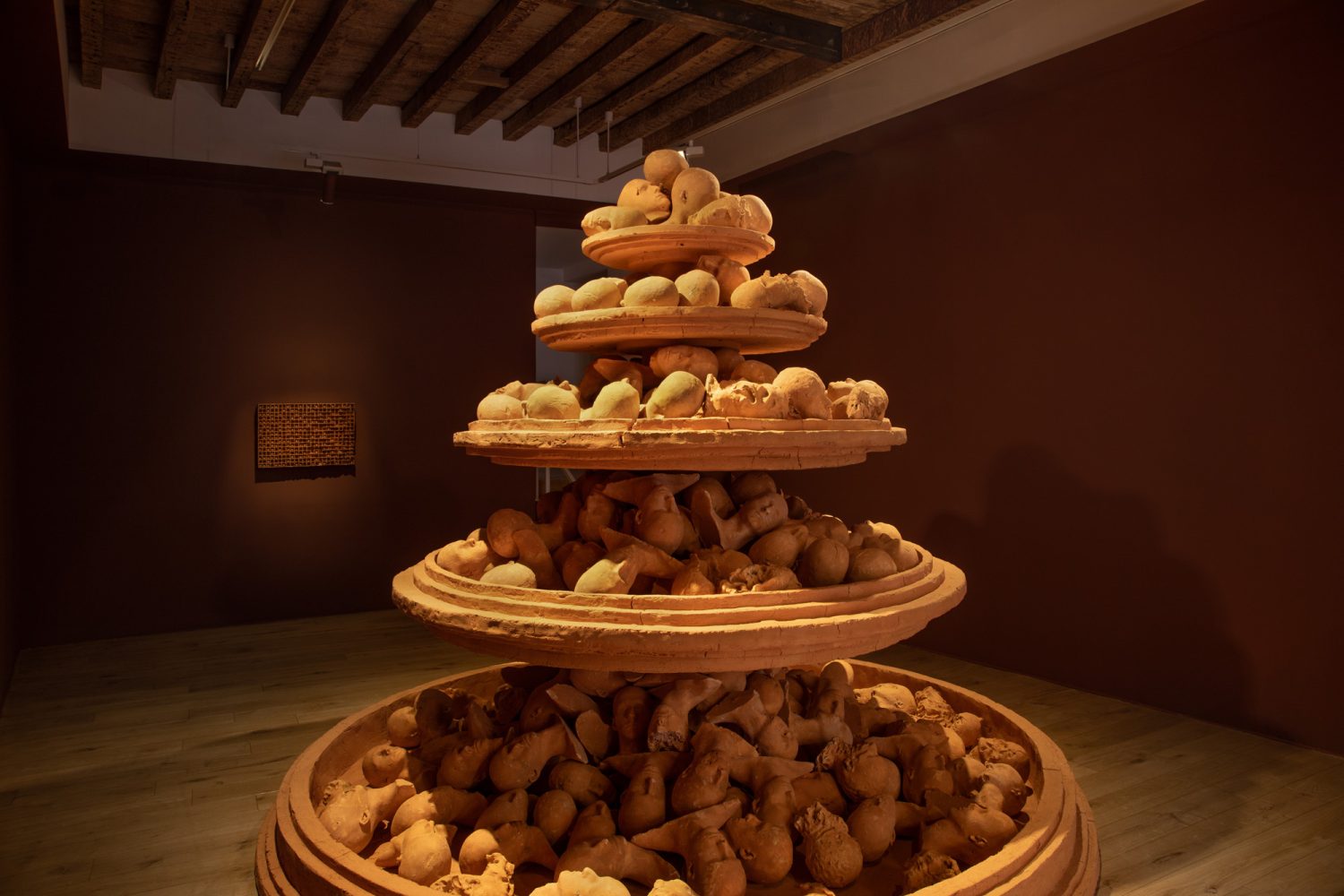
- Levi van Veluw